
Executive Coaching for B2B CEOs Scaling Past Founder Heroics
Coaching Isn’t Advice. Here’s the Difference You’re Paying For.
Let’s start with the question you’re actually asking: is executive coaching a real profession or an expense account?
Fair question. Most coaching content is written by people who’ve never sat in your seat, selling accountability they’ve never had. So instead of telling you coaching is worth it, I’ll show you what happens inside it, and you can do your own math.
$3,000/month·Weekly 1-hour sessions·Virtual·Month to month
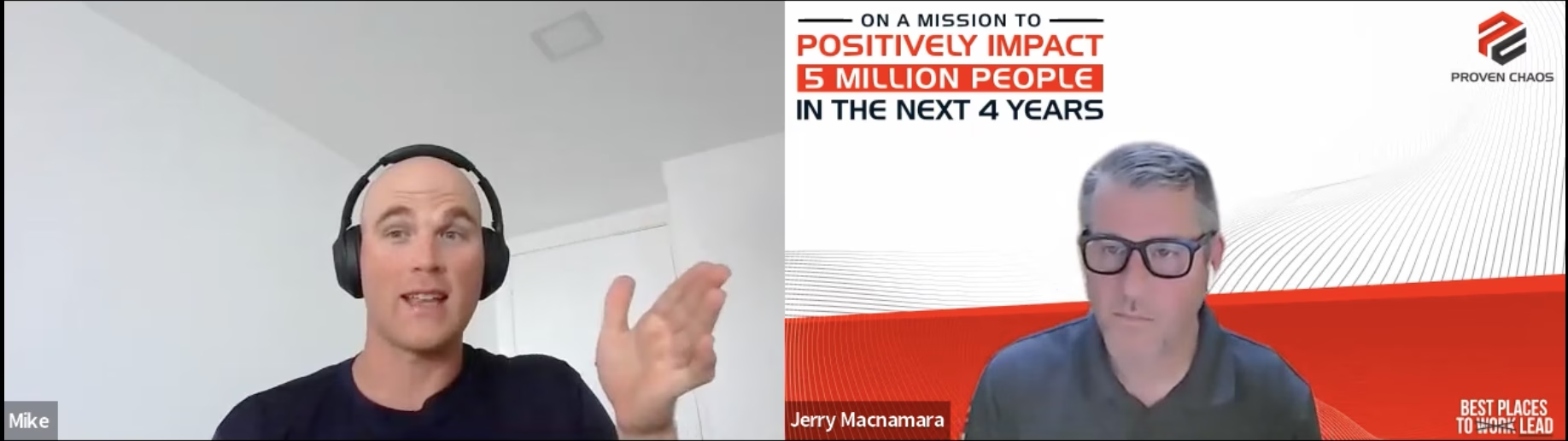
I don’t sit across the table. I sit on your side of it.
I’m not a listener, not a therapist, not a cheerleader. I’m a second operator in your business, paid to see what you can’t see, name what you’re avoiding, and push you to move on the decisions you’re stalling.
For the duration of the engagement, your problems are our problems. When your org design is broken, it’s our broken org design to fix. I do my own homework between sessions: I know your numbers, your pipeline, the names of your key people. You get an operator who holds the meta-view you lose inside the day-to-day, and who stays attached to whether the advice actually worked.
An advisor weighs in and leaves. A consultant delivers deliverables. I deliver a changed CEO.
A real session, anonymized
A founder, call her Dana, opened a session with “my ops manager keeps missing deadlines and I think I have to fire him.” Standard coaching would workshop the firing conversation.
We didn’t. We pulled the last five deadlines he missed and found that four of them changed scope mid-stream, twice by Dana, in hallway conversations she’d forgotten. Her ops manager didn’t have a performance problem. Her company had an expectations problem, and she was the source. Mismatched expectations nobody said out loud, crashing behind the scenes: that’s the Invisible Operating System at work.
Firing him would have replayed the same collision with the next hire. Instead she installed one habit: expectations written down at handoff. The “performance problem” disappeared in a month.
That’s the job. Not advice. Not accountability theater. Taking what’s invisible and making it visible, then holding you to what you said you wanted.

“In a short few months, Jerry helped change my business more than I have in the last 5 years. … I have worked with several smart business mentors, but nothing has compared to Jerry’s passion, directness, and generosity.”
Kevin Amolsch · President, Pine Financial
No pitch. No obligation.
Give me thirty minutes.
One honest conversation about how your company actually runs. You will walk out knowing the blind spots you cannot see from your seat, whether we ever work together or not.
What you should expect from me
01
I challenge, and then I hold firm
Coaches who only ask questions are performing a trick. Most of what’s blocking a CEO is a belief they haven’t examined, so I name the assumption under the argument: “You’re treating this as if X is given. Is it?” I push past the first answer, because the first answer is usually the one you’ve been practicing. And once we’ve established a truth, I don’t let you walk it back next week.
02
Accountability, in writing, every session
Commitments made verbally evaporate. Every session ends with a clean list: the specific deliverable, one named owner, a by-when. Every next session starts with a review of the last list. Nothing hides. Missed commitments get named, not explained around. Three misses is a pattern, and patterns get named early.
03
Hard truths, delivered with care
Hard truths delivered with contempt destroy trust. Hard truths delivered with evident care land and change behavior. If you’re lying to yourself about a co-founder, a market, a hire, I say so, now, not three sessions later when it’s advice nobody can use. Every hard thing I say comes from wanting you to win. Compassion isn’t niceness. Being nice usually means not telling the truth.
04
Productive discomfort, pointed forward
Coaching isn’t about making you feel better. It’s about making you see better. Those are different outcomes. The right kind of discomfort, the discomfort of seeing an avoided truth, is the fuel of real change. And reflection only matters insofar as it changes the next move: every session ends pointing at the next decision, not the last one.
A few of the questions you’ll hear, so you know what you’re signing up for: “What’s the assumption under that?” “What would have to be true for that to work?” “What’s the uncomfortable version?” “What’s the decision you’re avoiding?”
You’ll recognize yourself or you won’t
Everything runs through you. Decisions pile up on your desk. The business slows when you step away. That’s not a work-ethic problem. Your company runs on an operating system that lives entirely in your head.
You promoted your best doers and got your worst managers. They’re not failing you. There’s a line between accountability and policing, and most first-time managers land on the wrong side of it. That’s Coaching versus Catching.
You sit on decisions. A slow maybe does more damage than a fast no ever will. If your team stopped bringing you ideas, this is why.
If none of those stung, we’re probably not a fit, and I’d rather tell you that now.
The agenda belongs to your current constraint
This is a working partnership on the problems your organization hasn’t encountered before: decisions, executives, accountability, people, strategy, structure, priorities, conflict, your own behavior. Whatever is actually in the way this week is what we work on. A session that doesn’t move something real in the business is a failed session, and I’ll be the first to say so.
What it’s not: a sounding board, a canned curriculum, therapy, a cheerleader, or someone telling you how to run a company they’ve never run. I reject certification-handbook questions. Every question I ask has to be specific to this CEO, this situation, this decision.
The full fit test, including who we turn away: Who we work with →
The structure, published
Weekly one-hour sessions, virtual. Twelve sessions per quarter, so you get one week off to breathe. Month to month. No long-term contract, no annual commitment, no exit fee. If it stops being the highest-leverage hour in your week, stop.
$3,000 a month. Executive coaching runs $3,000 to $10,000 a month across the industry, and most coaches make you get three meetings deep before anyone says a number. I think that’s a tell.
The ROI question isn’t “is coaching worth $3,000 a month.” It’s “what does the bottleneck cost you a month.” For most CEOs running a $3M to $9M company that should be a $25M company, the answer makes the coaching fee look silly.
I’m not coaching from a book
Credentials, since you’re vetting: I was in senior leadership at 23. I’ve led five companies across B2B and B2C, took one from $5.9MM to $15MM in 18 months, put a construction company on the Inc. 500 twice while winning Best Places to Work, and hit the Franchise 500 three times. I’ve advised 100+ B2B companies since, from under $1MM to just shy of $1B.
What I care about more than your revenue: values fit. I work with leaders who care about their people, want to grow, operate ethically, and can hear hard things. I’ve walked away from bigger checks over that list, and I’ll keep doing it.

“He will guide and assist but not sugar coat or tell you something that you want to hear. He truly cares about the success of his proteges. His down to earth leadership style makes him an excellent mentor, coach, and friend.”
Anthony Halsch · CEO, RoxBox
Questions CEOs actually ask
How much does executive coaching cost?
Mine costs $3,000 a month: weekly one-hour sessions, twelve per quarter, virtual, month to month. The industry runs $3,000 to $10,000 a month, usually with the number hidden until the third meeting. No three-meeting dance here. The full pricing landscape, including what the rest of the market charges, is in How much does a CEO coach cost?
What’s the commitment?
Month to month. No long-term contract. The work compounds over quarters, but the decision to continue is yours every month.
Executive coach, business coach, consultant, or peer group: which do I need?
A consultant hands you answers. A peer group gives you perspective. A coach changes how you operate. I wrote an honest comparison of the rooms, including when not to hire me. The longer answer, with the two-minute test, is in CEO coach vs consultant.
What does a good session look like?
Something real moved in the business. At least one uncomfortable truth got named. You left with a concrete commitment, one owner, one by-when, and a question you hadn’t heard in that form before. If a session just felt nice and moved nothing, I’ll flag it before you do.
What’s the time commitment?
One hour a week, plus whatever you choose to do about what we uncover. Less than the bottleneck is already costing you.
Where are you based, and do you work in Jacksonville, Denver or Orlando?
ProvenChaos is based in Jacksonville, Florida, and the offer is the same everywhere: weekly, virtual, $3,000 a month. There’s a page written for each city: executive coaching in Jacksonville, executive coaching in Denver, where five current clients run companies, and executive coaching in Orlando.
Walk out knowing your blind spots.
Thirty minutes, no deck, no obligation. If coaching is the answer, I’ll show you exactly what it looks like. Or I’ll tell you it isn’t, and point you somewhere better.