
Client case study · Executive Coaching
Modern Engineering Solutions: The Firm Designed Around Its Founder’s Life
Michael Groselle, PE, built a water and wastewater engineering firm that competes on a named methodology instead of hourly rates, runs on numbers with actions attached, and funds the life he designed before he designed the business. Here is what he is proud of, in his words, and what we worked on together.
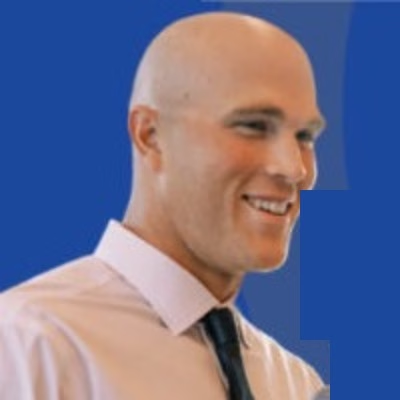
“Freedom isn’t the prize at the end. It’s the constraint you build against from day one. If you can’t answer where the next job is coming from, what the last one made you, and how long payroll is covered, you don’t own a business. You own a job with more risk.”
Michael Groselle, PE · Founder, Modern Engineering Solutions
The company
Modern Engineering Solutions. Civil engineering, water and wastewater. 285+ completed projects across nine states, plus a white-label channel serving other civil firms.
The CEO
Michael Groselle, PE, founder. Played volleyball around the world, traveled with his wife, and started a family in the same years he built the firm. Hosts a podcast that brings in buyers.
The work
Executive Coaching, weekly sessions. The work was naming what already lived in Mike’s head so the firm could run on it without him: the methodology the market buys, the numbers the team acts on, the decisions he no longer needs to be in.
What Mike is proud of (it is not the revenue number)
Ask most founders what they are proud of and they reach for a number. Mike reaches for a design decision.
“I’m proud that I built this deliberately and never traded my life to do it. Same stretch of years, I picked up multiple rental properties, played volleyball around the world, traveled with my wife, and started a family. The firm didn’t cost me any of that. It funded it.”
Michael Groselle, PE · Founder, Modern Engineering Solutions
That sentence is the whole case study. Everything below is what sits underneath it.
The firm runs the way it was designed to run
Engineering firms carry legacy baggage the way old buildings carry asbestos: nobody chose it, everybody works around it. Mike’s approach was to name every dysfunction he had watched elsewhere and build the opposite, on purpose. “None of the legacy baggage you find at most engineering firms,” he says. “Every dysfunction I watched elsewhere, we built the opposite. That’s why we’re attracting top talent right now.”
The most visible result of that design is how the firm sells. Most boutique engineering firms bill hourly, which makes them a commodity in a market that does not buy hours. Developers facing Texas TPDES permit timelines of 24 to 36 months buy certainty. MES named its permitting insight as a methodology, and delivers authorizations in 4 to 10 weeks against that standard. A named, repeatable, outcome-priced methodology is intellectual capital that travels without the founder. Judgment that lives only in the founder’s head is not.
The piece that makes all of it possible: measurement
In Mike’s words:
“Every department has numbers, and every number has an action attached to it. I know where work is coming from, what it costs to get, what margin it’s carrying, and how many months of payroll are in the bank, and I know what to do when any of those move. When I talk to other engineering firm owners, most of them can’t answer any of that. They find out they had a bad quarter when their accountant tells them in April. You can’t build freedom on top of that. You can’t even delegate on top of that.”
Michael Groselle, PE
This is the part most founders skip, and it is the part that makes the rest possible. Delegation without measurement is abdication; you hand off the work and lose sight of the result. Measurement with an action attached to every number is what lets a founder step out of the middle and still know, in ten seconds, whether the company is fine. Mike built that measurement layer. It is the same thing we mean by the invisible operating system made visible, and at MES it lives in how the firm runs rather than in who happens to be paying attention.
What we worked on
From the outside, MES looked like momentum: a growing project count, a white-label channel, inbound from a founder-hosted podcast. From the inside, too much of it still ran through one person: technical decisions, personnel tensions, client escalations, marketing, and the design of the firm’s own operating system. Jerry’s observation in an early session was blunt: “They’re just doing the doing. They’re processing. They’re not thinking.”
The coaching work was the founder bottleneck in its most common form, and the way out was the same three moves it usually is: make the judgment visible as a named methodology the market can buy, make the standards visible as numbers the team can act on without asking, and make the decision rights visible so the founder stops being the place where everything waits. Mike did the building. Weekly sessions were where the invisible got named.
What Mike would tell other founders
“Design the life first, then build the business to fit it. Most founders do it backwards: grind for 15 years, tell themselves freedom comes after the exit, and by then the marriage is thin and the kids are grown. Freedom isn’t the prize at the end. It’s the constraint you build against from day one.”
“And you don’t get there on instinct. If you can’t answer where the next job is coming from, what the last one made you, and how long payroll is covered, in ten seconds, without opening anything, you don’t own a business. You own a job with more risk. The metrics are what let you stop being the system.”
Michael Groselle, PE · Founder, Modern Engineering Solutions
Mike, on camera
The ten-second test Mike describes is a good one to run on yourself. Where is the next job coming from? What did the last one make you? How long is payroll covered? If the answers require opening something, that is the gap. The Scale Readiness diagnostic is the longer version of the same question.
Freedom is the constraint you build against from day one.
If your company still runs on instinct and you are the system, that is the first conversation.